
MVP Development

Know in weeks whether the idea holds.

Most product ideas don't fail because of the technology, but because nobody needs them. MVP development answers that question before the budget is burned. In weeks, we build a working product with real users that tests the one assumption everything depends on.
Book a discovery call
150
beta users in just three weeks, every listed lead sold
The problem

A year of development, and the market just shrugs

A product idea, a budget, time pressure. The biggest danger isn't building the wrong thing, it's doing it for too long before anyone notices.
  • Months go into features
    that nobody knows whether a single user will ever touch.
  • While the team polishes internally
    a faster competitor claims the market first.
  • The development budget flows into perfection
    when only a single assumption needs validating first.
Our approach

Validate first, then scale

We build MVPs that answer one clear question: does the market want this? Instead of developing the full feature set, we focus on the core that tests the central hypothesis. The result is a real product with real users and a codebase you can keep building on once the data holds up.

Scope Definition

We separate what proves the idea from what can wait. A sharp scope is half the battle.

Prototype Development

From clickable prototype to a working minimum viable product where users show their behavior, not just their opinion.

MVP Software Development

Clean, scalable MVP software instead of throwaway code. What we build also carries the next stage.

Validation & Measurement

Tracking from the start, so that after launch you know what works instead of guessing.
Case Study
01
Challenge
Capalead started with a business idea (a lead platform for agencies) but no product in the market to prove demand.
02
Approach
From idea to market-ready MVP on a lean low-code stack, six months from kick-off to go-live, including branding, waitlist, and a conversion-focused lead interface with a staged roll-out.
03
Results
150 beta users in the first three weeks, every listed lead sold. Business model validated on a manageable budget, as a solid proof of concept for further development.

How we work.

How it works

Fixed phases, clear touchpoints, and one dedicated contact throughout the project. The client's market knowledge feeds directly into the scope, so the MVP tests exactly the hypothesis that matters.

Clear terms

Fixed-price estimate with transparent tracking and reporting, billed monthly or by milestones. The estimate is binding, no nasty surprises at the end of the project. Full handover guaranteed: code and concept belong to the client. We stay on board afterwards, with ongoing support and team onboarding.
Workshop

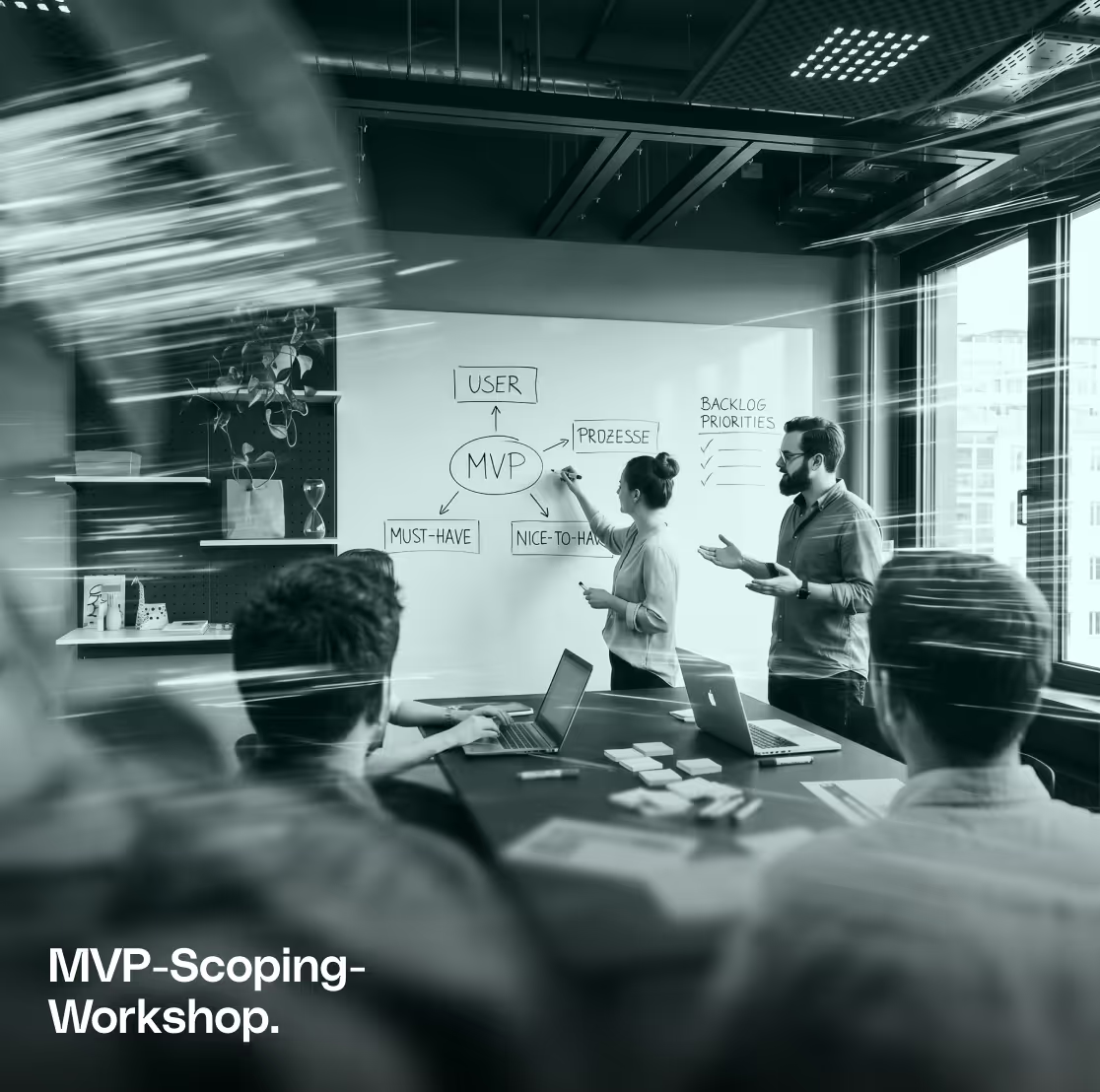
MVP Scoping Workshop: feature list out, hypothesis in

In a focused workshop, we jointly sharpen which single assumption the MVP needs to test and which features are truly necessary for it. Online or on site with us, with a concrete scope and effort estimate as the outcome.

Request a workshop

Why founders and product teams choose Webnique for their MVP development

We build MVPs that don't end up in a dead end. Many agencies deliver quick throwaway code that has to be rewritten from scratch after validation. We come from custom development and design for scale from the start, without overloading the MVP. Strategy, design, and development come from one team, and where it makes sense, we build AI features directly into the product. A team that understands the idea before writing a single line of code.


In Detail

Developing MVP software: from idea to market-ready product

01.

Hypothesis & Success Criteria

We define the central assumption and the metric that makes success measurable.
Without a clear criterion, every launch is guesswork. Before anything is built, we define which assumption the MVP must prove and at what value it counts as confirmed.
01.

Scope Definition & Feature Prioritization

Every feature has to justify why it belongs in the first release.
We prioritize ruthlessly. Anything that doesn't contribute to validation goes on the roadmap, not into the MVP. That keeps the build small and fast.
01.

Prototype Development & Testing

A clickable prototype makes the concept tangible before development time is spent.
This catches flawed assumptions early, while changes are still cheap, instead of discovering them in the code.
01.

Technical Architecture

A tech stack that gets you to market fast and still scales.
No over-engineering, but no dead end either. The architecture carries the MVP today and the next stage of growth tomorrow.
01.

MVP Software Development

Development in short cycles with regular interim releases.
Progress becomes visible, not just a status update. Every cycle delivers something testable instead of disappearing into a black box for months.
01.

Onboarding & First User Experience

The first impression decides whether users stay.
We design the entry point so curiosity turns into usage. A weak onboarding would otherwise distort every validation result.
01.

Tracking & Analytics

Measurement from day one, built in.
Which feature gets used, where users drop off, what drives conversion. Without data, validation is just an opinion.
01.

Launch & First User Feedback

The minimum viable product goes to real users.
Feedback is collected in a structured way instead of waiting for random opinions. Real usage behavior beats any assumption from the conference room.
01.

Evaluation & Roadmap

After launch, we evaluate the data together.
From there we derive what gets built, expanded, or dropped next. The roadmap follows the data, not gut feeling.
01.

Scaling & Further Development

When the data holds up, development continues on the existing foundation.
From MVP to full product, without starting over. The codebase was designed to grow from day one.

Find out in one conversation whether the idea is MVP-ready

A short conversation is enough to roughly outline the scope and assess what the first release needs to deliver. No strings attached, and concrete.
Book a discovery call
Frequently asked questions

FAQs

What does MVP development cost?

The cost depends on the scope, i.e. how many features the first release needs. A focused MVP for a simple application usually starts in the mid five-figure range. We narrow down the effort in a discovery call.

How long does it take to develop an MVP?

A sharply scoped MVP is usually live in six to twelve weeks, larger projects take up to a few months. What matters is not the technology but how precisely the scope is defined.

What is the difference between a prototype and an MVP?

A prototype shows how a product should look and feel, usually without real functionality. A minimum viable product is a working product that real users actually use and, ideally, pay for.

Does the client own the code afterwards?

Yes. Everything we develop is handed over in full: code, concept, and access. There is no lock-in with us to keep building on it.

MVP agency or in-house development team?

Building your own team costs months and fixed overhead before the first line of code is written. An MVP agency delivers an experienced, well-coordinated team right away and scales back down flexibly after launch.

What happens to the MVP after launch?

We evaluate the usage data together and derive the next steps from it. On the existing codebase, the product grows step by step into a full product.

Can AI features be part of the MVP?

Yes. Where an AI feature is at the core of the idea or clearly increases the value, we build it in directly, such as smart search or an LLM-powered feature.

What distinguishes MVP software from a finished product?

MVP software focuses on the one core function that tests the central assumption. Anything that doesn't contribute to validation deliberately comes later.

Can my MVP be built with no-code?

For simple validations, a no-code or low-code approach can be enough and saves time. As soon as the MVP needs real scaling or custom logic, cleanly developed MVP software is the better foundation.